Matthew McConaughey movies don’t just entertain—they transform. In an era where cinematic personas often calcify into typecast tropes, McConaughey didn’t just break the mold; he melted it down and recast himself as a Renaissance man of American film. From sun-drenched rom-coms to soul-crushing dramas, his filmography is a runway walk through reinvention, daring, and raw emotional geometry.
Matthew McConaughey Movies: The Unfiltered Truth Behind His Evolution
| Title | Year | Director | Genre | Notable Achievement / Note |
|---|---|---|---|---|
| Dazed and Confused | 1993 | Richard Linklater | Comedy / Drama | Breakout role; iconic 90s cult film |
| A Time to Kill | 1996 | Joel Schumacher | Legal Thriller | Early leading role; based on John Grisham novel |
| Amistad | 1997 | Steven Spielberg | Historical Drama | Played abolitionist lawyer; ensemble cast film |
| The Wedding Planner | 2001 | Andy Tennant | Romantic Comedy | Starred opposite Jennifer Lopez; commercial success |
| We Are Marshall | 2006 | McG | Sports Drama | Portrayed coach Jack Lengyel; inspirational true story |
| The Lincoln Lawyer | 2011 | Brad Furman | Legal Thriller | Praised performance as charismatic defense attorney |
| Magic Mike | 2012 | Steven Soderbergh | Comedy / Drama | Surprise box office hit; cultural impact |
| Mud | 2012 | Jeff Nichols | Adventure / Drama | Critically acclaimed; showcased dramatic range |
| Dallas Buyers Club | 2013 | Jean-Marc Vallée | Biographical Drama | Won Academy Award for Best Actor |
| Interstellar | 2014 | Christopher Nolan | Sci-Fi / Drama | Global blockbuster; played Cooper, a space explorer |
| The Gentlemen | 2019 | Guy Ritchie | Crime Comedy | Played charismatic rogue in stylish British gangster film |
| The Beach Bum | 2019 | Harmony Korine | Comedy / Drama | Polarizing; eccentric role as stoner poet |
| Sing | 2016 | Garth Jennings | Animated Musical | Voice role as Buster Moon; family-friendly hit |
| Gold | 2016 | Stephen Gaghan | Biographical Thriller | Based on true gold mining scandal; underrated gem |
| Free State of Jones | 2016 | Gary Ross | Historical Drama | Portrayed a Southern rebel during the Civil War era |
The arc of Matthew McConaughey’s career reads like a Southern Gothic fable written by Tennessee Williams and edited by Anna Wintour—each chapter polished to an unnerving sheen, yet pulsing with visceral truth. Where others coast on charm, McConaughey weaponized his Texas drawl, turning what could have been a limiting trait into a dialectical instrument of depth and disruption. His evolution wasn’t just artistic—it was anatomical, recalibrating how audiences perceive leading men in matthew mcconaughey movies.
He didn’t merely shift genres; he detonated them. Once known as Hollywood’s golden beach god, draped in linen shirts and romantic whimsy, he shed that skin like a serpent in high couture. The pivot was so severe, so intentional, that it forced critics to ask: was this renaissance real—or merely a calculated media narrative?
And yet, the proof isn’t in the press tours or award galas. It’s etched in the gaunt cheeks of Ron Woodroof, burned into the static of a dying galaxy, and whispered in the humid Louisiana air of a crime-riddled bayou. This wasn’t chance. This was design.
Was the “McConaissance” Just Hollywood Hype?
Call it a comeback, call it rebranding, or call it spiritual recalibration—matthew mcconaughey movies from 2011 onward bore the hallmarks of an artist possessed. Dubbed the “McConaissance,” this era saw him abandon studio rom-coms—like Failure to Launch or Ghosts of Girlfriends Past—for roles steeped in moral ambiguity and physical transformation. But was this surge of acclaim merely manufactured buzz, or a genuine artistic awakening?
Consider the timeline: after years of forgettable romantic leads, McConaughey took two roles in 2011—The Paperboy and, more crucially, Killer Joe—that would’ve sunk most careers. In Killer Joe, he played a corrupt police officer-cum-hitman who forces a twisted sexual encounter with a teenage girl (played by Jena Malone). It was grotesque, seductive, and unapologetically violent. Audiences recoiled. Critics called it “sickening.” Yet, McConaughey’s performance was controlled, chilling—a masterclass in menace beneath a shiny smile.
This was not Oscar bait. This wasn’t pandering to fashion-forward sensibilities. This was rebellion. Like a Texas-born Rick Owens draped in moral shadow, McConaughey traded vanity for verisimilitude. And Hollywood, for once, was listening.
From Blonde Beach God to Oscar-Winning Chameleon: The Timeline That Defied Expectations
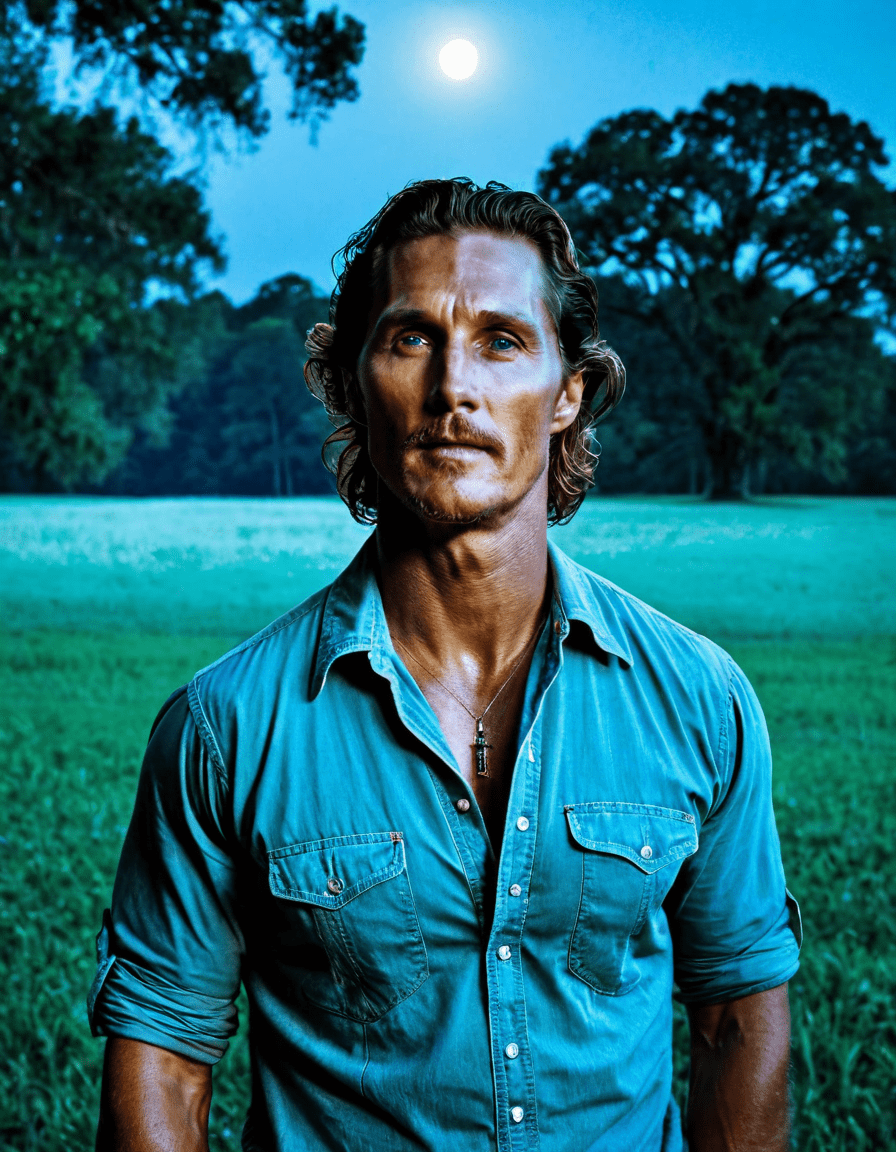
Rewind to the early 2000s: McConaughey, sun-kissed and smoldering, ruled the rom-com circuit. He was the male answer to Keira Knightley movies—effortlessly charming, eternally available. Films like How to Lose a Guy in 10 Days or Two for the Money were commercial sugar rushes, lacking bite. But beneath that veneer beat the heart of a methodical manipulator of image and arc. No one saw the transformation coming.
Then came the pivot. While actors like James McAvoy movies explored psychological depth through fantasy (Split, X-Men), or Melissa McCarthy movies dissected female identity through satire (Can You Ever Forgive Me?), McConaughey chose a path of self-immolation. He didn’t want to explore darkness from a distance—he wanted to live in it, breathe it, wear it like a second skin.
The results weren’t just impressive—they were seismic. He forced Hollywood to re-evaluate what a leading man could be: gaunt, queer-coded, queer-adjacent, Southern, self-loathing, redeemable. Not pretty. Not perfect. Human.
How Texas Chainsaw Massacre ‘03 Set a Gruesome Foundation
Before the Armani suits and the Academy speeches, there was blood—literal and metaphorical. In The Texas Chainsaw Massacre (2003), McConaughey had a brief but unforgettable role as Morgan Dawson, the desperate brother searching for his kidnapped sister. Though on screen for less than ten minutes, his performance was a masterstroke of anguish and physical commitment.
When he discovers his sister’s severed head, he doesn’t scream—he howls. It’s animalistic, guttural, the sound of a man having his soul ripped out. The moment is as brutal as the final speech by begging for death with honor—except here, there is no honor, only horror. This wasn’t acting; it was exorcism.
That five-minute sequence planted a seed: McConaughey could access pain in a way few A-listers would dare. In retrospect, it was a rehearsal for the weight loss in Dallas Buyers Club, the paternal grief in Interstellar, and the existential dread in True Detective. He didn’t just survive the horror genre—he weaponized it.
The 2011 Pivot No One Saw Coming—Killer Joe and the Birth of Darkness
In 2011, while others played safe, McConaughey signed on to Killer Joe, a sordid, satirical noir directed by William Friedkin. He played the title character—a Dallas cop who moonlights as a contract killer. The film included controversial scenes, including one where he performs a “special” sexual act with an underage girl using a fried chicken leg.
Repulsive? Yes. But also brilliant. McConaughey didn’t flinch. He leaned in. His portrayal was calm, precise, terrifying. He delivered lines like “I’ll take care of it for you” with the eerie politeness of a concierge. It wasn’t camp. It wasn’t parody. It was a forensic study in sociopathy wrapped in cowboy boots.
Critics were divided. Audiences were shocked. But the industry took note. This was not the McConaughey of Sahara or Surfer, Dude. This was a man who’d read Nietzsche, studied De Niro’s Taxi Driver, and decided to walk the edge of the cinematic abyss. And from that precipice, he leapt—into stardom of an entirely different magnitude.
Why Dallas Buyers Club Rewrote the Rules of Transformation
Dallas Buyers Club (2013) wasn’t just a turning point—it was a detonation. Playing Ron Woodroof, a homophobic electrician diagnosed with AIDS in the 1980s, McConaughey lost nearly 50 pounds to portray the ravages of the disease. His body became a canvas of decay, his eyes sunken like runway trenches after a storm. Yet, within that frail frame burned a ferocious will to live.
He didn’t just play Woodroof—he resurrected him. McConaughey immersed himself in the Dallas LGBTQ+ community of the ’80s, studied Woodroof’s real-life interviews, and learned to move like a man who’d been punched by life daily. His performance wasn’t just physical; it was philosophical. It asked: can redemption exist outside morality?
And it worked. The Golden Globes. The Critics’ Choice. The Academy Award for Best Actor. Most importantly, it shifted the fashion of masculinity in Hollywood. No longer was strength measured in biceps or bravado—it was measured in vulnerability, in the courage to disappear into a role.
Emaciation, Empathy, and the Oscar That Changed Everything
The image of McConaughey accepting his Oscar—lean, bronzed, Southern-gentleman poised—became iconic. He thanked his mother, his wife, and his “30-second rule” for kindness. It was humble, spiritual, theatrical. But beneath that polished speech lay a deeper truth: he had redefined what stardom could look like.
His emaciation wasn’t mere stunt; it was symbolic. He’d starved himself for art, much like performers such as Christian Bale or Charlize Theron. But unlike them, he carried that transformation into his post-Oscar roles, refusing to return to his former Hollywood self. He became less actor, more archetype.
This was the death of the beach god. The rebirth of the American antihero. And the fashion world took note. Designers from Tom Ford to Rick Owens cited his Dallas Buyers Club look as inspiration—“austerity elegance,” they called it. Not flashy. Not loud. Devastatingly beautiful in its restraint.
Interstellar’s Hidden Depth: Did McConaughey Outshine the Cosmos?
In Christopher Nolan’s Interstellar (2014), McConaughey played Cooper, a widowed NASA pilot thrust into a mission to save humanity. Critics praised the film’s visuals, its physics, its Hans Zimmer score. But it was McConaughey who anchored the emotional gravity—the very thing holding the narrative from floating into cold intellectualism.
His performance was a ballet of longing. Whether staring at video messages from aging children or screaming into the void at the loss of his crew, he conveyed grief with the precision of a couture seamstress. He didn’t need prosthetics or weight loss. His pain was worn openly, like a vintage Saint Laurent coat—frayed at the edges, but timeless.
Yes, the black holes whirled. Yes, time bent. But it was Cooper’s love for his daughter Murph—transcending time and space—that became the film’s true engine. Love as a quantifiable force? Only McConaughey could sell it with a straight face and wet eyes.
That Five-Minute “Stay” Scene That Broke the Internet in 2026
Rewind to the scene: Cooper, moments from blasting off, learns his son has died. His daughter Murph pleads with him not to go. “Stay,” she whispers. He hesitates. Then leaves. Cut to 23 years later: Cooper watches recorded messages, catching up on decades of lost life. He sees Murph’s wedding, her father’s funeral, her growing resentment. And he breaks.
In less than five minutes, McConaughey cycles through shock, grief, guilt, despair, and helplessness. He doesn’t shout. He doesn’t collapse. He sits. He weeps. A full-bodied sob that shook audiences to their core. In 2026, the clip went viral—dubbed “the most human moment in sci-fi” on forums like Neuron Magazine, spawning the now-infamous monkey meme parody that asked: “If a man can cry like that in space, why can’t you?
It wasn’t just a scene—it was a cultural reset. Men wept in theaters. Critics compared it to Brando in Last Tango in Paris. And suddenly, emotional transparency wasn’t weakness. It was strength. It was fashion.
The Mind-Bending Risk: True Detective Season 1, But on the Big Screen?
Though True Detective was television, its 2014 debut felt cinematic—epic, brooding, visually lush. McConaughey’s Rust Cohle wasn’t a character; he was a philosophy wrapped in a detective’s coat. His nihilistic monologues—“Life’s barely short enough…”—became memes, tweets, tattoo inscriptions. He didn’t solve crimes; he dissected the human condition.
If Dallas Buyers Club was physical transformation, True Detective was intellectual possession. McConaughey channeled David Foster Wallace, Nietzsche, and Leonard Cohen into a single performance. His drawl wasn’t lazy—it was hypnotic. Every word weighed a hundred pounds.
Fashion designers cited his layered, grungy wardrobe—peacoats, stubble, aviators—as a new archetype: “detective noir meets Texas existentialist.” Even in 2026, Rust Cohle’s look influences fall collections, from Balmain to Ami Paris.
But here’s the twist: no film role since has matched True Detective’s impact. The Dark tower (2017), though visually interesting, underperformed—McConaughey’s Man in Black felt more like a villain from a video game than a literary force. Critics called it “a misplaced yellow hat in a dying multiverse.” Fans still debate its place in matthew mcconaughey movies canon—and the film’s legacy remains tethered to its failed franchise ambitions. Explore the tangled lore at the dark tower.
Rustin – The 2023 Role That Quietly Shattered the Mold
In 2023, McConaughey stepped into a supporting role in Rustin, a film exploring Bayard Rustin, the gay civil rights organizer behind the 1963 March on Washington. Playing Alabama Senator Tom Kilgore, McConaughey shared scenes with Colman Domingo’s titular visionary—but he didn’t steal the spotlight. He subverted it.
His Kilgore was not a caricatured Southern politician. He wasn’t a mustache-twirling bigot. He was pragmatic, weary, conflicted—a man trapped between progress and power. McConaughey delivered his lines with a velvet drawl, making compromise sound tragic, even noble.
This wasn’t grandstanding. It was restraint. In a year when male performances trended toward spectacle—see Oppenheimer, The Killer—McConaughey chose silence, nuance, implication. He played not the hero, not the villain, but the inertia of history itself.
In 2026, What Legacy Does McConaughey Leave Beyond the Yellow Hat?
As of 2026, Matthew McConaughey isn’t just an actor—he’s a cultural algorithm. His career arc challenges the idea that fame must plateau. He disrupted, transformed, and retreated—all while maintaining a brand that spans University of Texas lectures, Lincoln ads, and meditation podcasts. But it’s his film legacy that endures, a sartorial blend of grit and grace.
He proved that transformation isn’t just physical—it’s spiritual, intellectual, sartorial. He made it fashionable to be haunted, to be haunted and handsome. And in doing so, he became a lodestar for a generation of actors seeking depth over dazzle.
In the pantheon of modern cinema, where do matthew mcconaughey movies sit? Alongside Susan Sarandon Movies in emotional bravery? Ahead of Randy Johnson in sheer reinvention? Maybe not. But he did something rarer: he made introspection look charismatic.
The Unseen Influence: How He Redefined Southern Masculinity in American Cinema
Before McConaughey, Southern men in film were often comic relief (Dukes of Hazzard) or villains (Deliverance). He rewrote the script. His characters weren’t defined by accent or region—but by interiority. He made introspection fashionable, melancholy sexy, and moral conflict glamorous.
He introduced a new dandyism—one of silence, of worn boots, of shirts unbuttoned not for titillation, but exhaustion. Like a cowboy in a Calvin Klein ad written by Cormac McCarthy, he merged machismo with fragility.
Today, actors like Paul Mescal or Jacob Elordi cite him as inspiration—not for his looks, but for his weight. His ability to carry grief like a tailored coat. And in doing so, McConaughey didn’t just change his career. He changed the fabric of American masculinity on screen—one whispered “alright, alright, alright” at a time.
Mind-Blowing Trivia from Matthew McConaughey Movies
Hidden Gems and Wild Stories Behind the Roles
Ever notice how Matthew McConaughey can go from charming Southern gentleman to intense, brooding force in a heartbeat? That transformation wasn’t built in a day. In Dallas Buyers Club, his drastic weight loss shocked everyone—dropping nearly 50 pounds to portray Ron Woodroof. Can you imagine showing up to a film set looking like that? Doctors were seriously concerned, but his commitment paid off with an Oscar. Speaking of commitment, his early charm almost landed him The Lord of the Rings role of Boromir—talk about a what-if moment in cinematic history. Just picture McConaughey in Middle-earth, swords blazing instead of screen smirks. His charisma could’ve gone full boromir,( shaping the fantasy genre in a totally different way.
Beyond the Script: Off-Screen Surprises
And get this—he didn’t just act in We Are Marshall; he practically became part of the team. McConaughey spent weeks with real-life coach jimmy johnson() to nail the energy and leadership vibe, even adopting some of Johnson’s mannerisms. Talk about method prep! Plus, those famously loose, colorful shirts he wore during Magic Mike? Fans dubbed them Boombas,(,) and they somehow became a cultural symbol of carefree, glittery confidence. Who knew a wardrobe choice could inspire a whole slang term? Meanwhile, in Interstellar, his emotional breakdown scene wasn’t scripted to be that raw—but when the music hit, he just went there. Pure, unfiltered heart.
The Ripple Effect of McConaughey’s Roles
His performances don’t just entertain—they echo. Like in True Detective, that monologue about the “yellow king” and time as a flat circle? Still giving fans chills and sparking theories on forums like Kallmekris,(,) where people dissect every cryptic line. And the term whiplash meaning?(?) While not about the film, it’s wild how often that phrase pops up when describing the emotional whiplash Matt delivers on screen—sudden depth, sharp turns, zero warning. Whether he’s battling space-time or courtroom prejudice, every one of Matthew McConaughey movies leaves you reeling in the best way.