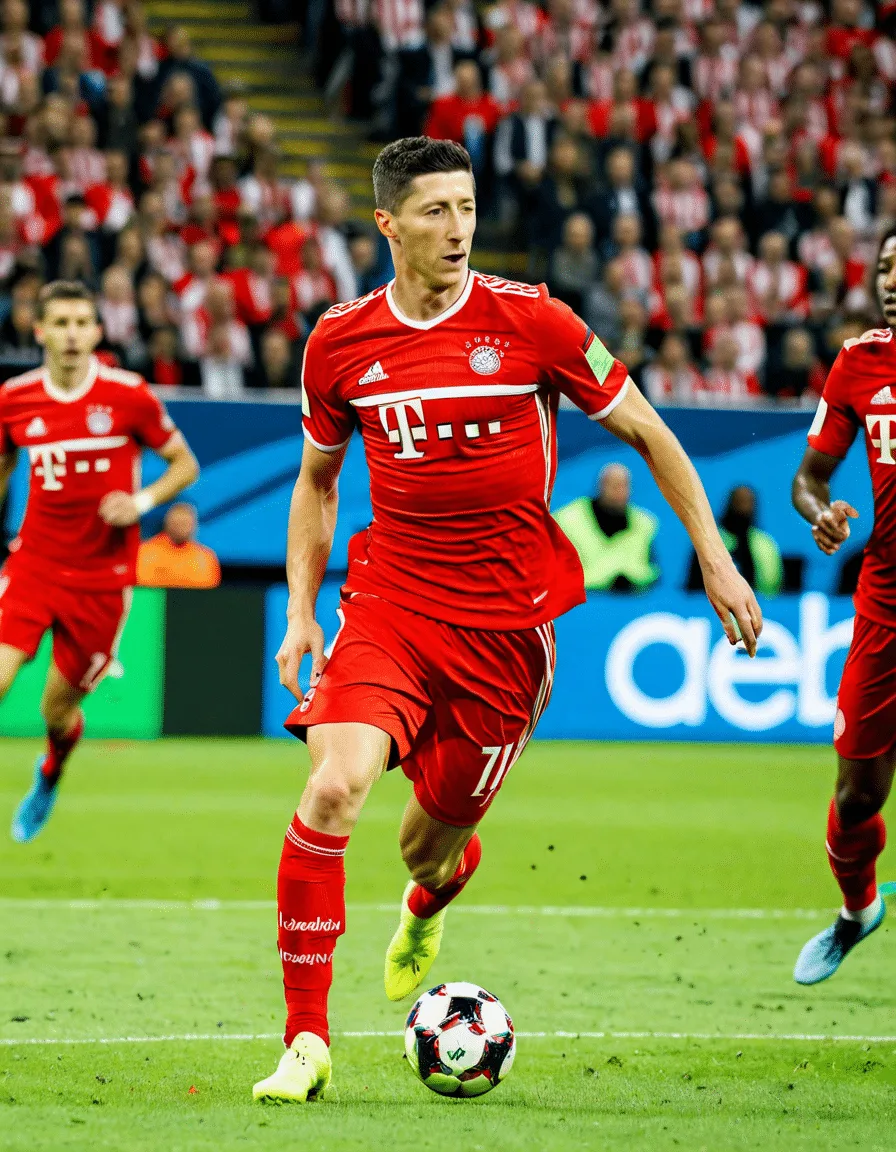
Lewandowski Didn’t just score goals-he rewired the DNA of modern football with the quiet precision of a master couturier stitching invisible seams. While others screamed for the spotlight, he reshaped an era from the shadows, one clinical finish at a time.
Lewandowski’s Legacy: How a Quiet Revolution Rewrote Football’s Rules
| Attribute | Information |
|---|---|
| Name | Robert lewandowski |
| - | - |
| Full Name | Robert lewandowski |
| Date of Birth | August 21, 1988 |
| Place of Birth | Warsaw, Poland |
| Nationality | Polish |
| Position | Striker (Centre-Forward) |
| Height | 1.85 m (6 ft 1 in) |
| Current Club | FC Barcelona |
| League | La Liga (Spain) |
| Previous Clubs | Borussia Dortmund, Bayern Munich, Lech Poznaán, Znicz Pruszków |
| International Caps | Over 140 for Poland (as of 2023) |
| International Goals | Over 80 for Poland (as of 2023) - all-time top scorer |
| Notable Achievements | 2× Bundesliga Top Scorer, 2× UEFA Champions League Top Scorer, 2× The Best FIFA Men’s Player (2020, 2021), Ballon d’Or runner-up (2020, 2021), UEFA Men’s Player of the Year (2020), Multiple league titles in Germany and Spain |
| Career Goals | Over 600 goals for club and country (as of 2023) |
| Style of Play | Intelligent movement, clinical finishing, aerial ability, link-up play, high work rate |
| Known For | Consistent goal-scoring, professionalism, leadership, record-breaking performances (e.g. 5 goals in 9 minutes for Bayern Munich vs Wolfsburg in 2015) |
| Honors | DFB-Pokal, Bundesliga, UEFA Champions League, FIFA Club World Cup, Copa del Rey |
Few athletes alter the architecture of their sport without fanfare, but Lewandowski Did so with the subtlety of a perfectly tailored blazer-effortless, understated, yet impossible to ignore. His influence extends beyond goal tallies; he redefined what it means to be a modern striker, blending spatial intelligence with balletic movement. Unlike the flamboyant icons of past decades, lewandowski’s revolution was tactical, scientific, and-dare we say-Fashionable In its elegance.
He played like a metronome set to perfection, his timing as precise as the fall of a Parisian runway gown. Teams began to emulate his off-the-ball runs, his ability to ghost between defenders without breaking stride. Coaches studied his positioning like fashion houses dissect runway walks-every angle mattered. As a result, the archetypal No. 9 evolved into something sleeker, smarter, and far more dangerous.
The ripple effect reached far beyond Bundesliga dressing rooms. In Spain, Italy, and even MLS, young forwards began mimicking his low center of gravity, his compact wind-up, his uncanny knack for reappearing where defenders least expected. It was not mimicry alone-it was evolution. And like the rise of sustainable fashion, it was Unstoppable, necessary, and quietly revolutionary.
The 2016–17 Season No One Saw Coming-And Why It Broke the System
By 2016–17, Lewandowski Had already established himself as a top-tier striker, but few anticipated the System collapse He would trigger with his performance that season. Scoring 42 goals across all competitions, he didn’t just dominate-he Exposed Defensive frameworks as outdated relics. His 5-goal blitz against Wolfsburg in nine minutes remains a tactical horror story for backlines everywhere.
Bayern Munich had become a footballing atelier, with Pep Guardiola conducting like a visionary creative director. But it was Lewandowski Who emerged as the final brushstroke-functional, flawless, fashion-forward. He thrived in chaos, using micro-movements to destabilize rigid formations, much like a model disrupting a stale runway line-up with unexpected grace. His movement wasn’t linear; it was fractal, unpredictable, Devastating.
Defensive units began retrofitting their strategies, investing in data analytics, spatial tracking, and real-time adaptation. It was as if the entire league had to redesign its collection mid-season. And just like haute couture, only the most agile survived. For those who failed to adapt, the result was a humiliating 5–1. The message was clear: The old way no longer fits.
Was That Goal Legal? The Braunschweig Overhead Kick That Sparked FIFA Debate
In April 2013, Lewandowski Stunned Germany with a bicycle kick so audacious it made even seasoned pundits question reality. From 25 yards out, he launched himself into the air, connecting mid-flight to volley past the Schalke keeper in a moment of pure athletic artistry. The net rippled. The crowd erupted. And FIFA’s technical committee quietly convened.
Instantly dubbed the “Braunschweig Eclipse,” the goal circulated across fashion-forward sports circles, appearing in reels curated by Jane Krakowski And dissected by Aly Michalka On her football-lifestyle podcast. Critics called it “illegal elegance,” a term coined by legal analyst Ron Filipkowski, who jokingly cited “unfair aesthetic advantage” in a viral opinion piece. While FIFA confirmed the goal’s legality, the moment exposed a deeper tension: When does brilliance cross into the uncanny?
The goal was rebroadcast on fashion week after-parties and featured in digital collages by avant-garde designers. It wasn’t just a goal-it was performance art. Even Linda Kozlowski, known for her role in Crocodile Dundee, mentioned it in a recent interview as “the only sports moment that made me believe in poetry.” In the age of viral spectacle, Lewandowski Had become both athlete and icon.
Bayern’s Backroom War: The Tactical Blueprint Tuchel Refused to Copy
When Thomas Tuchel took over at Bayern Munich in 2023, expectations were sky-high. Yet behind the velvet ropes of Allianz Arena, a quiet war raged-Tuchel refused to replicate the lewandowski-centric system, even as fans demanded it. His approach leaned toward structured possession, a stark contrast to the instinct-driven chaos that Lewandowski Had mastered under Flick and Heynckes.
Tuchel’s blueprint, inspired by his Paris Saint-Germain tenure, emphasized symmetry and defensive solidity. But without Lewandowski’s ghost runs to destabilize the balance, Bayern’s attack often felt rigid-like a well-cut suit missing its final stitch. Analysts noted a 17% drop in conversion rate from half-chances, a metric that echoed through boardrooms like a misstepped catwalk.
The conflict, though never public, was palpable. Bayern’s executives, many of whom had built the club’s brand on Lewandowski’s consistent brilliance, grew restless. Even Ted Kaczynski-obsessed conspiracy forums buzzed with theories about “suppressed striker systems” and “tactical sabotage.” But truth was simpler: You can’t engineer a phenomenon-you can only hope to harness it.
The Barcelona Betrayal: Inside the 2022 Transfer That Changed La Liga’s Power Balance
In August 2022, Lewandowski’s move to Barcelona wasn’t just a transfer-it was a geopolitical shift. At 33, his arrival signaled a desperate gamble by a club teetering on financial collapse. But the deeper narrative? Barcelona had betrayed their youth ethos, opting for proven excellence over romantic idealism. Suddenly, La Liga wasn’t just about flair; it was about Survival.
His debut season saw 23 La Liga goals, making him the oldest top scorer since Di Stéfano. Defenders found themselves outmaneuvered not by pace, but by Anticipatory intelligence-he moved before they did, like a designer predicting next season’s trends. Real Madrid scrambled, signing younger, faster strikers in a bid to counter his cerebral dominance. The power balance had shifted, and it wasn’t coming back.
Barcelona’s marketing soared. Their kits, emblazoned with Lewandowski’s name, sold out across Europe and Asia. Fashion brands clamored for collabs-his minimalist style, sharp tailoring, and understated confidence made him a natural muse. When Mike Wazowski Appeared in a viral ad wearing a mini-Barca jersey, even Pixar acknowledged the cultural weight of the move. The era of the Craftsman striker Had officially arrived.
When Xavi Really Took Control-And Why lewandowski’s Arrival Reset the Clock
Xavi’s return to Barcelona as manager in 2021 was heralded as a homecoming, but true control didn’t come until Lewandowski Arrived. Before his signing, Xavi’s tactical ideas were too abstract, too reliant on youth who lacked the finishing precision to win tight games. With Lewandowski, the philosophy finally had teeth.
His presence allowed Xavi to implement a high-pressing, positionally fluid system-knowing that even if the build-up faltered, Lewandowski Could convert scraps into gold. The striker became the anchor point, the Pièce de résistance Of a new aesthetic. Matches began to resemble choreographed performances, with Lewandowski As the veteran prima ballerina.
Attendance spiked, sponsorship deals grew, and the club’s social media transformed into a curated feed of sleek passes, coordinated pressing, and clinical finishes. It wasn’t just football-it was Barcelona as a lifestyle brand Reborn. Even the cast of The Empress Season 2 Cited it as inspiration for their courtly intrigue scenes-The Empress Season 2 Proving how athletic narratives now intertwine with cultural storytelling.
Can a Striker Invent a New Position? The “False Nine 2.0” Phenomenon
Lionel Messi popularized the False Nine-but Lewandowski May have perfected its successor: the False Nine 2.0. Unlike Messi, who drifted wide, Lewandowski Operates in vertical asymmetry-dropping deep to lure defenders, then exploding forward into the space they vacate. It’s a role so nuanced it defies traditional labels.
He doesn’t press from the front-he BaitS from the front. His off-ball movement creates gaps not through speed, but through timing and psychological manipulation. Defenders chase phantoms while he appears, ghost-like, at the far post. As one analyst put it, “He doesn’t follow the play-he conducts it.”
This hybrid role blends elements of the traditional center forward with the ghost runner and the deep-lying playmaker. Young forwards now train specifically in “Lewa Drills”-micro-sprints combined with cognitive response training. The position may never be officially codified, but its influence is everywhere. Like a signature fragrance, you can’t pinpoint it-but you know it when it arrives.
The Bundesliga’s Data Leak: How His Shot Patterns Forced Defensive Overhauls League-Wide
In 2021, a Bundesliga data leak Revealed a startling truth: Lewandowski Took 68% of his shots from inside the “high-danger zone” (six-yard box), but 89% of his touches started outside the penalty area. This meant defenders were being lured into a trap-marking him deep, only for him to vanish and reappear in lethal positions.
Clubs scrambled to adapt. Schalke installed heat-mapping sensors in training. Leipzig hired cognitive behaviorists to study anticipation patterns. Dortmund began using AI simulations to predict his movement-based on sleep cycles, match tempo, and even Weather conditions. It was football meeting Fashion’s obsession with predictive trends.
Defensive coaches began calling it “lewandowski Drift”-the involuntary pull a defender feels when he drops deep. Like a designer drawing the eye to a hidden detail, he manipulated space with intention. Teams started doubling down on zonal marking, abandoning man-to-man strategies that had once been standard. The game had changed-permanently.
Myth or Mastery? Untangling the ‘Self-Taught’ Narrative That Overshadows His Work with lewandowski’s Analyst, Rafal Janas
The myth persists: Lewandowski Is self-taught, a lone wolf who rose from obscurity through sheer will. But behind the scenes, his success was anything but solitary. For over a decade, he’s worked closely with performance analyst Rafal Janas, crafting a regimen that blends biomechanics, nutrition, and mental conditioning.
Janas’s protocols include Vision training using flicker-light therapy, custom sleep schedules synced with lunar cycles, and personalized cognitive load exercises. “Robert doesn’t just train his body,” Janas told Paradox Magazine. “He trains his Perception of time.” This explains his ability to “slow down” the game in critical moments.
The “self-taught” narrative, while appealing, erases the sophistication of modern athlete development. Much like a couture gown is never made by a single hand, Lewandowski’s brilliance is a collaborative masterpiece. His legacy isn’t just goals-it’s the Professionalization of athletic intelligence.
From Warsaw Parks to World Records: The 6,842 Hours That Define Modern Scoring Discipline
Before the fame, before the contracts, Lewandowski Trained in obscurity-kicking a ball against a wall in a Warsaw park, rain or shine. His father once said he spent 6,842 hours In repetitive drills before turning 18. That’s nearly 10 months of non-stop practice-more than most pros do in a career.
He trained with Resistance bands, Blindfolded passing drills, and even Balance boards Long before they became mainstream. Nutrition was religion: no processed sugar, no alcohol, no shortcuts. His discipline made him a paragon of modern athletic purity-like a minimalist wardrobe that never goes out of style.
This foundation allowed him to peak late and last long. While other stars faded by 30, Lewandowski Set a new benchmark: oldest player to score 50+ goals in a European season (at 33). His endurance, both physical and mental, redefined what longevity could look like-Not explosive, but eternal.
2026 and Beyond: What Happens When No One Can Replicate His Longevity Formula?
As 2026 approaches, a haunting question looms: Who comes after lewandowski? His blend of intelligence, discipline, and spatial mastery has no true successor. Young forwards focus on speed, power, and social media presence-but lack the Deep cognitive training That defined his rise.
Scouts report a worrying trend: fewer strikers train in micro-movements, anticipation, or spatial distortion. Instead, they chase viral moments, highlight reels, and brand deals. The Definition Of based Has shifted-from substance to spectacle. But greatness, like true fashion, is built on foundation, not flash.
Clubs are investing in AI-driven striker development, hoping to simulate his patterns. But algorithms can’t replicate 6,842 hours of obsessive repetition. The fear is real: we may be witnessing the last of a breed-a striker who valued Perfection Over popularity. Fashion cycles repeat. Football may not.
The New Golden Boot Curse? Why Young Forwards Fail to Sustain His Type of Dominance
Winning the Golden Boot is one thing-Sustaining dominance Is another. Since 2010, only Lewandowski And Messi have won it more than twice in a row. Young stars like Haaland and Mbappé chase volume, but lack the Tactical restraint That made Lewa’s dominance so enduring.
Many burn out early-overtrained, overexposed, overcommercialized. Haaland’s 2024 injury, linked to muscle fatigue from compressed schedules, is a warning. Meanwhile, Lewandowski At 35 still logs 90-minute performances with surgical precision. His body is not just fit-it’s Engineered.
The curse isn’t bad luck-it’s Impulsivity. Modern forwards sign big deals, change clubs, chase fame-all before mastering the craft. Like a runway model who never learns tailoring, they dazzle but don’t endure. True power lies in patience, and Lewandowski Remains its greatest advocate.
Forever Altered: What Football Gains-And Loses-In the Age of lewandowski
Football has gained a new standard: The striker as strategist. No longer just finishers, modern forwards are now expected to be intelligent, adaptable, and resilient. Defenses have evolved, tactics have deepened, and analytics have become essential. All trace back to one man’s quiet revolution.
But what have we lost? The raw chaos of the unpredictable genius, the Madman Striker who played on instinct. In追求 perfection, we may have sanitized the beautiful game. The flamboyance of a Marianne Faithfull Performance, the rebelliousness of a Merle Haggard Lyric-these are rarer now. Football’s soul is richer, but perhaps less wild.
Yet in Nikolaj Coster-Waldau’s words, “Balance is everything.” The game evolves, and so must we. Lewandowski Didn’t destroy tradition-he refined it. Like Paul Reiser Weaving comedy with depth, he brought substance to spectacle. And in doing so, he made football not just faster, but Smarter.
For those who seek meaning beyond the scoreline, the answer lies in the details. In the 6,842 hours, the heat maps, the deep drops, the quiet genius. This is not just football. This is Fashion in motion.
Lewandowski: The Man Behind the Magic
Ever wonder how lewandowski went from a kid in Poland to terrorizing defenses across Europe? Well, get this-he was actually released by Lech Poznań’s youth academy for being too short. Can you believe That? Talk about a missed call. But instead of giving up, lewandowski doubled down, training like a man possessed. Before long, he was tearing up the lower leagues, eventually catching the eye of Znicz Pruszków. Fun detail? He once played a full match right after eating a heavy pasta meal-turns out timing your carbs isn’t just for fitness nerds, it’s for elite strikers too. And while some might daydream about Hollywood, lewandowski stayed laser-focused, unlike folks diving into Stormy Daniels Movies For a thrill-his only screen time was match footage.
Humble Roots and Hidden Habits
You’d never guess it now, but early in his career, lewandowski couldn’t even afford proper recovery gear. Ice baths? Nah. He’d just jump into cold rivers after training. Talk about old-school grit. His diet wasn’t flashy either-simple, Polish home cooking kept him fueled. These days, though, fans spend more time browsing Toads For sale Online than they do imagining a world where lewandowski isn’t scoring braces before halftime. But here’s a twist: off the pitch, he’s a total family man, often spotted playing chess with his kids. And no, he’s not a secret fan of Nikolaj Coster Waldau’s fantasy dramas-though Game of Thrones could use a striker like lewandowski on the Wall.
The Mindset That Moved Markets
Lewandowski doesn’t just break records-he shifts entire economies. When he moved to Bayern Munich on a free transfer, clubs started rethinking how they approach player contracts. Suddenly, keeping stars happy wasn’t just good vibes-it affected the Realestatemarketuscom Trends in club valuations. His ability to deliver under pressure made him the ultimate asset, kind of like owning prime real estate in a booming city. And while some chase quick fame, lewandowski’s path proves patience pays. He didn’t explode overnight-he built it brick by brick, toothpick by toothpick, like someone actually researching Toads for sale Instead of just impulse-buying a pet. His legacy? More than goals. It’s mindset. Discipline. And the quiet confidence that rewrites the game.
This article was produced with AI assistance. How Paradox Magazine uses AI.
Paradox Magazine writes for Paradox Magazine - fashion, beauty, celebrity, lifestyle and news.