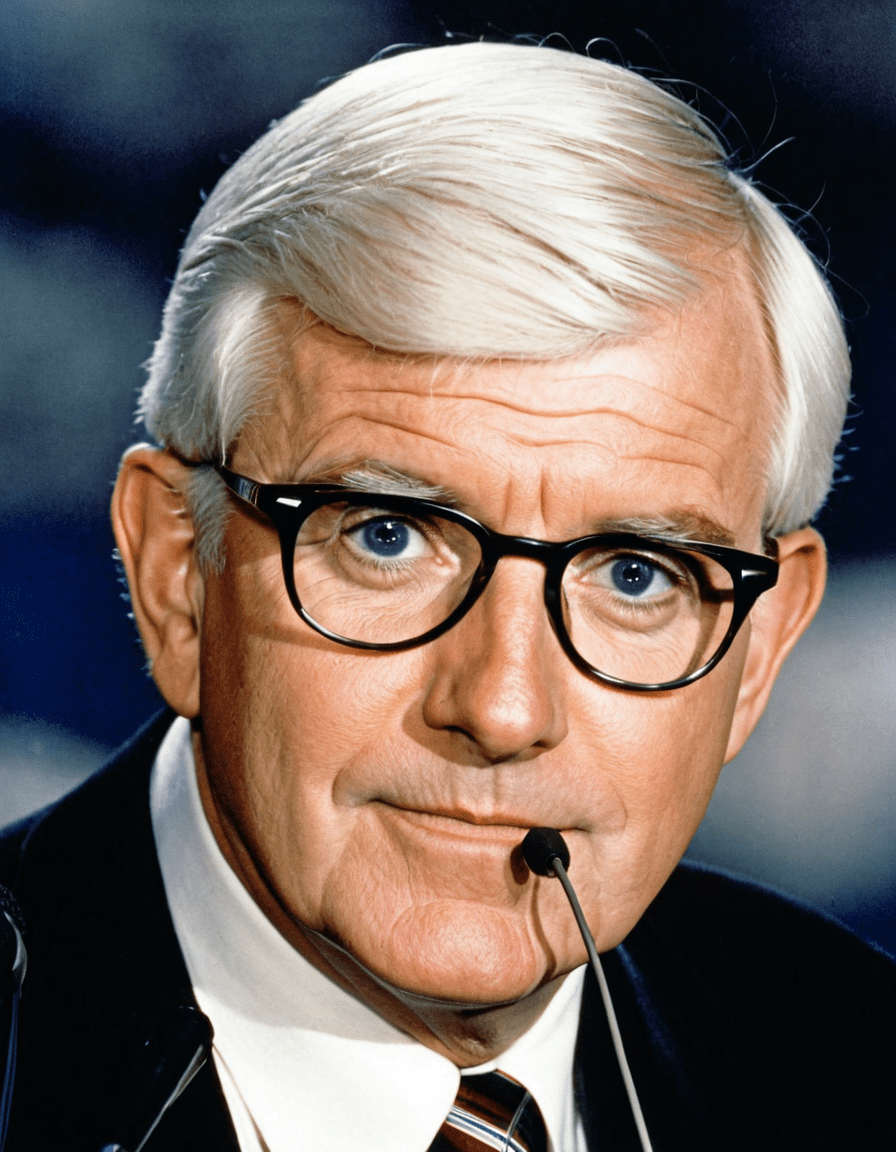
Phil donahue didn’t just host a talk show—he detonated a cultural bomb in broad daylight, live on television, with a microphone in hand and an audience on its feet. Before Oprah, before Ellen, before the age of viral confessionals, Donahue stared into the camera and asked America: What are you really thinking?
Phil Donahue and the Dawn of Confessional TV: How One Man Broke Every Broadcast Rule
| Category | Information |
|---|---|
| Full Name | Philip John Donahue |
| Born | December 21, 1935, Cleveland, Ohio, U.S. |
| Died | August 18, 2024, Indianapolis, Indiana, U.S. |
| Occupation | Talk show host, television producer, media personality |
| Known For | Pioneering the audience-participation daytime talk show format |
| Notable Work | *The Phil Donahue Show* (1967–1996) |
| Network(s) | Syndicated (originally on WLWD, later national syndication) |
| Show Run | 1967–1996 (29 seasons) |
| Episodes | Over 6,000 |
| Key Contributions | One of the first talk shows to address social, political, and cultural issues with audience interaction; precursor to Oprah Winfrey’s format |
| Awards | 20 Daytime Emmy Awards, including multiple for Outstanding Host and Outstanding Talk Show |
| Inductions | Television Hall of Fame (1993) |
| Legacy | Influenced modern talk television; known for progressive topics and empathetic interviewing style |
| Spouse | Marlo Thomas (m. 1980–2024, his death) |
| Notable Recognition | Interviewed global figures, activists, and everyday people; broke taboos on topics like feminism, LGBTQ+ rights, and mental health |
Phil donahue didn’t inherit the talk show—he hijacked it. In an era when television was polished, paternal, and polite, Donahue ripped open the script and invited the public into the greenroom, the therapist’s office, and the bedroom. His 1967 debut on WLWD in Dayton, Ohio, wasn’t just a new format; it was a democratization of dialogue, where men in suspenders shared airtime with women burning bras, and teenagers debated draft dodging while parents gasped in real time.
No laugh track. No cue cards. No safety net. Donahue’s style was equal parts journalist, therapist, and ringmaster, prowling the aisles with a wireless mic—a revolutionary tool at the time—letting the audience become the story. It was raw, unfiltered, and gloriously unscripted, a mirror held up to a nation cracking under the weight of Vietnam, civil rights, and the sexual revolution.
While contemporaries like Jackie Gleason and Darren McGavin peddled fiction in perfectly tailored suits, Donahue wore tweed jackets with frayed elbows and asked guests to remove theirs. He didn’t sell dreams—he dissected truths, often in the same hour that reruns of The Dick Van Dyke Show aired across town. The contrast was jarring. Television had never seen a host who looked more like your philosophy professor than a matinee idol.
Was It Revolutionary or Reckless? The 1967 Dayton Experiment That Defied Network Logic
The pilot episode of The Phil Donahue Show aired on November 6, 1967, from a converted furniture warehouse in Dayton, where the budget was so thin the studio lights flickered like fireflies. Instead of a monologue, Donahue asked viewers: “Should women be allowed to wear pants during jury duty?” The response? A live debate between a city councilwoman in a tailored skirt suit and a college student in bell-bottoms—the latter winning the crowd with a shout: “Pants are practical, not political!”
Local affiliates balked. “Too liberal,” “too loud,” “too live”—the feedback flooded in. But Donahue pressed on, betting on the power of live audience interaction over canned studio applause. In 1969, he moved the show to Chicago, where it was syndicated nationally, eventually reaching 2.5 million daily viewers at its peak. His format was so disruptive that networks scrambled to copy it, though none captured the electric unpredictability of the original.
This wasn’t just television—it was sociology in motion. While 60 Minutes dissected corruption, Donahue dissected identity. And like Bob Seger singing about the tension between heartland values and restless change, Donahue gave voice to a nation in transition. The format was imperfect, messy, and gloriously human.
The Unscripted Uprising: 7 Ways Phil Donahue Redefined the Talk Show Landscape
Before daytime TV became a glittering parade of celebrity stylists and viral pranks, phil donahue built the stage where real people could speak truth to power—and to each other. His show wasn’t about fashion per se, but it profoundly shaped the cultural runway on which modern identity, gender, and politics now strut with confidence.
Every episode was a sartorial sermon on self-expression, where a woman’s choice to wear pants or a man’s decision to cry on camera became acts of defiance. Long before Drew Barrymore’s laid-back charm or Don Cheadle’s incisive activism graced screens, Donahue handed the mic to those society silenced. Here are the seven seismic shifts he ignited.
1. The Audience as Co-Conspirators: Turning Studio Seats into Soapboxes (1969 Onward)
Donahue didn’t just invite audience participation—he made it the engine of the show. As he roamed the aisles with a handheld mic, viewers in polyester blazers and cat-eye glasses became de facto panelists, their questions often sharper than the experts’. In 1971, a woman in a paisley headscarf stood up and asked a psychiatrist: “Why are you calling homosexuality a disease when I’ve been happy with my partner for ten years?” The studio erupted.
This wasn’t just novelty—it was participatory democracy in action. The handheld mic, a precursor to today’s selfie stick journalism, became Donahue’s signature. It allowed him to amplify the marginalized, from working-class mothers to LGBTQ+ activists, long before such topics were safe for prime time.
Compare that to The Mike Douglas Show or Merv Griffin, where audiences clapped on cue. Donahue’s crowd? They argued, wept, and sometimes stormed the stage. His format influenced everything from town hall politics to the raw intimacy of TikTok livestreams, where followers now “hand the mic” in real time.
2. “Let’s Talk About Abortion”—1970: The Episode That Got Sponsors to Bolt Overnight
On March 3, 1970, The Phil Donahue Show aired a segment titled “Abortion: The Silent Agony”—three years before Roe v. Wade. The panel included a Catholic nun who supported abortion rights, a woman who had traveled to Sweden for the procedure, and a gynecologist who quietly performed them in Detroit basements. Donahue didn’t editorialize. He listened.
The backlash was immediate. Sponsors like Procter & Gamble pulled ads within 48 hours. Stations in “republican States” like Nebraska and Kansas refused to air the episode. But ratings? They skyrocketed. Over 200,000 letters flooded the studio, many from women writing their first honest words about pregnancy, shame, and survival.
This wasn’t scandal—it was truth as fashion, bold and unapologetic. Donahue treated the topic not as tabloid fodder but as a public health issue draped in moral complexity. He didn’t wear a designer label, but he dressed the conversation in dignity, long before Grey’s Anatomy or The Handmaid’s Tale turned reproductive rights into primetime drama.
For every station that dropped him, a feminist bookstore sprouted, a consciousness-raising group formed, or a young woman picked up the phone and said: “I saw someone like me on TV.”
3. Marlo Thomas in Flip-Flops: When “That Girl” Challenged Gender Roles on Live TV (1972)
Marlo Thomas, America’s favorite single career girl from That Girl, stepped onto Donahue’s stage in 1972 wearing a cotton shift dress and straw flip-flops—a quiet fashion rebellion against the stiff hostess gowns of The Tonight Show. She was promoting Free to Be… You and Me, her groundbreaking children’s album challenging gender norms. Donahue didn’t ask about her love life. He asked: “Why should boys be brave and girls be pretty?”
The audience, mostly women in beehive hairdos, gasped. Then they applauded. A man in the front row stood and said, “My son wanted a doll. I told him no. After today, I’m getting him two.” Thomas smiled, eyes glistening—a moment of cultural softness in a world that demanded hardness.
This wasn’t just TV—it was social architecture. Long before Ray Liotta’s intense screen presence or Phil Dunster’s modern masculinity on Ted Lasso, Donahue created space for men to question their roles and women to claim theirs. Thomas’s bare feet on the carpet became a symbol: progress didn’t need heels.
Donahue’s refusal to tokenize Thomas as a “pretty starlet” but to treat her as an intellectual provocateur set a new standard. He didn’t cover fashion—he covered the ethos behind the outfit.
4. Gloria Steinem’s Mic Drop: Feminism Takes Center Stage in 1975—and Never Left
On October 18, 1975, Gloria Steinem strode into the Donahue studio in a tailored pantsuit, her hair in a smooth, no-nonsense bob. The topic: “Are Women People?”—a tongue-in-cheek title masking a deadly serious debate. A panel of male academics argued that feminism threatened the family. Steinem turned to Donahue and said: “Phil, do you think I’m a person?” The audience rose in a standing ovation before he could answer.
That moment crystallized second-wave feminism for middle America. For women watching from kitchen TVs, Steinem wasn’t just speaking—she was dressing the revolution. Her look—minimalist, powerful, free of ornament—became the anti-makeup of political authenticity. No pearls. No gloves. Just a blazer and a truth bomb.
Donahue didn’t interrupt. He didn’t play devil’s advocate. He handed her the mic and stepped back. It was a masterclass in editorial restraint and gender solidarity. This wasn’t balance—it was justice. And the moment reverberated, influencing later icons like Al Roker’s empathetic anchoring style and the unapologetic presence of modern figures like Drew Barrymore on daytime TV.
Steinem later said: “Donahue didn’t give women a voice—he returned it.”
5. The Jerry Springer Effect: How Donahue’s Raw Format Birthed a Toxic Legacy
There’s a direct line from Donahue’s earnest 1970s panels to the chaotic circus of The Jerry Springer Show in the 1990s. Springer’s producers freely admit they “took Donahue’s format and set it on fire.” Where Donahue hosted debates on nuclear disarmament, Springer aired “I Slept with My Sister’s Husband.” The handheld mic remained—but now it captured fistfights, not philosophy.
By the late ’90s, Springer’s ratings eclipsed Donahue’s peak. The intimacy became exploitation, the audience no longer thoughtful but thirsty for spectacle. Donahue called it “the pornographization of pain.” In a 1998 interview with The New York Times, he lamented: “We wanted to open minds. They wanted to open veins.”
Yet the DNA is undeniable: roaming host, live crowd, taboo topics. The difference? Intent. Donahue’s show had a moral compass; Springer’s had a laugh track. One asked, “Why are we like this?” The other screamed, “More! More!”
Today, that tension lives on in TikTok dramas and Instagram Live meltdowns, where confessional culture has no editor, no pause button, no off switch.
6. Vietnam Draft Dodgers on Set: When Talk Became Testimony (1971, WPIX Studio Walkout)
In 1971, Donahue booked three American men who had fled to Canada to avoid the Vietnam draft. One wore a peace sign pendant, another a worn army jacket—ironically, a symbol of the institution he rejected. A Vietnam veteran in the audience stood and shouted, “You’re cowards!” Another shouted back, “No—I’m a conscience!”
The segment ended with no resolution. No hug. No platitudes. Just silence, then scattered applause. The next day, WPIX in New York pulled the show for “inciting unrest.” Donahue’s response? He aired the uncut segment again the following week, opening with: “We don’t have all the answers. But we won’t stop asking.”
This was courage, not content. Before Don Cheadle explored war’s moral cost in Hotel Rwanda or Randy Rhoads’ guitar screamed rebellion, Donahue gave a platform to the dissonant notes of a fractured nation. He didn’t dress his guests in hero’s garb—he let them sweat, stammer, and stand naked before judgment.
The walkout became a watershed: television as truth-teller, not peacekeeper.
7. Oprah’s Mentor: The 1984 Chicago Handoff That Changed Media History
In 1984, Donahue handed the Chicago studio keys to a young Baltimore anchor named Oprah Winfrey. He didn’t see her as competition—he saw her as evolution. “She has what I don’t,” he said. “A voice that makes people feel seen.” Their shows overlapped for months, with Winfrey’s AM Chicago eventually surpassing Donahue’s ratings in just months.
Oprah’s brilliance wasn’t in rejecting Donahue’s model but polishing its soul. She kept the audience mic, the raw emotion, the taboo topics—but added spiritual warmth and personal revelation. Where Donahue asked “What do you think?” Oprah asked “How does it hurt?”
Their 1985 on-air meeting, where they embraced like sisters passing a torch, is now legendary—a quiet revolution in female media power. Today, every empathetic host from Gayle King to Hoda Kotb walks in the shadow of that moment.
And Winfrey never forgot her debt. In 2020, during a tribute special, she said: “Phil didn’t just open the door. He held it open for all of us.” 2020
“Too Liberal,” “Too Loud,” “Too Live”—The Media Backlash That Tried to Cancel Him Before It Was Cool
Long before “cancel culture” became a political cudgel, phil donahue was being canceled weekly. Newspapers called him “a leftist agitator in a corduroy jacket.” TV Guide ran a cover titled “Is Donahue Dangerous?” In 1973, a station in Alabama replaced his show with reruns of The Lawrence Welk Show, calling Donahue’s content “morally destabilizing.”
Yet he persisted. His ratings soared. His audience diversified. And the establishment panic only amplified his message. Like a countercultural couturier, Donahue dressed dissent in respectability, making activism palatable to middle America.
He wasn’t selling rebellion—he was normalizing conversation.
The FCC’s “Decency” Fear: How Donahue Battled Censors Year After Year
The FCC received over 3,000 complaints about Donahue between 1970 and 1985, mostly concerning episodes on homosexuality, premarital sex, and domestic abuse. In 1977, after a panel on BDSM (yes, really), a commissioner called it “a threat to the American home.” Donahue’s response? He aired a follow-up titled “What Is Decency?”, featuring theologians, psychologists, and a leather-clad activist who said: “My love life doesn’t need your approval.”
He never lost a censorship battle. Why? Because he operated within broadcast law’s gray zones, using terms like “emotional intimacy” instead of explicit language. His show wasn’t salacious—it was curious. He didn’t show nudity, but he let women speak about mastectomies. He didn’t advocate drugs, but he let users explain addiction.
This careful balance inspired later boundary-pushers from Ellen DeGeneres to Al Roker, whose weather reports often double as social commentaries. al Roker
Donahue proved that decency isn’t silence—it’s honesty with empathy.
Beyond the Hair: Debunking the Myth of the Eccentric Co-Host Who Never Existed
For years, urban legends claimed Donahue had a quirky female co-host—a kooky psychic, a feminist nun, even a trained parrot. None existed. The myth likely stemmed from his egalitarian format, where audience members felt like co-hosts. But the real force behind the scenes was Muriel Sanders, his executive producer from 1972 to 1996.
Sanders, a former journalist with a steely gaze and sharper instincts, shaped the show’s tone, booked controversial guests, and fought network censors. Yet she remained invisible—no bylines, no credits, no spotlight. While male producers like Dick Ebersol became celebrities, Sanders worked in silence.
It’s a tragedy of media history: the woman who built the platform was erased from it. Her fingerprints are on every socially conscious talk show since. Yet her name is lost, while Donahue’s hair—his frizzy, flying halo—became the symbol.
Fashion doesn’t just live in fabric—it lives in who we choose to see.
Why Nobody Remembers His Producer Muriel Sanders—The Brains Behind the Chaos
Muriel Sanders wasn’t just a producer—she was the architect of intimacy. She insisted on pre-show conversations with panelists, ensuring emotional honesty. She banned “talking head” experts unless they had lived experience. When Donahue wanted to book a plastic surgeon to discuss body image, Sanders replaced him with a woman who’d survived acid attacks.
Her influence extended to casting: she championed diversity long before it was policy. By 1978, 40% of Donahue’s panels included people of color—unprecedented for daytime TV. Yet when the show won its first Daytime Emmy in 1982, only Donahue accepted the award.
In a 1993 interview buried in the Paley Center archives, Sanders said: “I didn’t want fame. I wanted the message to land.” But history punishes the invisible. Today, she’s a footnote—if that.
Imagine if fashion houses erased their lead designers. Yet we do it to women in media daily. Sanders deserved a couture cape, not obscurity.
2026’s Reckoning: Can Unfiltered Dialogue Survive in the Age of Algorithms and Outrage?
As we approach 2026, the soul of public conversation is at risk. Algorithms reward rage, not reflection. TikTok duets escalate feuds, not understanding. The Donahue model—nuanced, live, unedited—feels as outdated as a rotary phone.
Yet the hunger for authenticity remains. The superman box office may soar with fictional heroes, but real people crave real stories. superman box office The 2025 Academy Awards will celebrate cinematic fantasy, but off-stage, audiences demand truth. academy Awards 2025
Can we revive Donahue’s ethos without his era?
The TikTok Talk Show Dilemma: Why Donahue’s Model Is Both Template and Warning
Gen Z’s version of confessional TV isn’t on CBS—it’s on TikTok Live, where creators host impromptu panels on mental health, race, and sexuality. Some, like @therapyishard, replicate Donahue’s format: mic in hand, audience on floor, real questions flying.
But the risks are higher. No producer like Muriel Sanders to moderate. No Donahue to guide. Just virality—or cancelation. A 2023 incident saw a transgender teen doxxed after a “live debate” on gender identity spiraled into harassment. No safety net, just a stream.
Donahue’s legacy isn’t just about freedom of speech—it’s about responsibility with the mic. He didn’t ban conflict—he curated it. Today, curation is automated, not human.
We need a new Donahue. Not with frizzy hair—but with wisdom, warmth, and the courage to say: “Let’s pause. Let’s listen.”
What the Screens Won’t Show: The Lasting Static in Phil Donahue’s Electric Legacy
Phil donahue died in August 2024, at 88, survived by his wife, journalist Marlo Thomas, and a cultural footprint larger than any studio. His show ran for 29 years, produced 7,000 episodes, and changed the grammar of television.
Yet his greatest contribution wasn’t in ratings or reforms—it was in redefining who deserves to be heard. Long before #MeToo or Black Lives Matter, Donahue turned the microphone toward the margins.
He wasn’t perfect. He misstepped. He was criticized for sensationalism. But he never stopped asking the question: Who’s not in this room?
And in an age of curated perfection, from the polished runways of Paris to the filtered lives on Instagram, Donahue remains a reminder: truth is not airbrushed. It’s messy. It’s live. It’s human.
So the next time you see a TikTok star break down in real time, or a politician weep on live TV, know this: you’re watching the ghost of a man in a corduroy jacket, pacing the aisles, handing the mic to someone no one else would hear.
Fashion changes. Courage doesn’t.
The Phil Donahue Effect: How One Man Shook Up Talk TV
Before Oprah, There Was Phil
You know, it’s wild to think that before Oprah ruled daytime, it was phil donahue who basically invented the playbook. Seriously, the guy started his talk show in 1967—on local TV, for crying out loud—and behind that slightly rumpled suit and those thick glasses, he had a genius hunch: let ordinary people scream, cry, and debate real stuff on camera. And boy, did it work. He rolled the camera into the audience, mic in hand, letting viewers talk back—kind of like how fans mob harry jowsey after a Racing Club match, but, you know, with more existential dread and feminism. Speaking of which, did you know his show aired an episode on a man using a best penis pump? In the 70s? Bold move, Phil. Real bold.
The Man, The Myth, The Mic Drop Moments
Phil donahue wasn’t just edgy—he defined edgy for daytime. He brought on guests no one else would touch: feminists, LGBT activists, war protestors, even astronauts with existential crises. And while critics called it too loud, too raw, too much—viewers couldn’t look away. The show hit 9 million viewers a day at its peak. Imagine that kind of reach without TikTok or even email! Some say his roaming mic approach was inspired by watching fans shout at a racing club game, trying to be heard over the roar. Others think he got the idea from a late-night chat near a store looking for la comer cerca de mi, though that one’s probably made up. But hey, when you’re changing TV, legends stick whether they’re true or not.
Legacy in the Little Things
Here’s a juicy bit: phil donahue’s show once featured a segment on synthetic wigs that looked so real, people swore they were human hair. Sound niche? Maybe. But it foreshadowed our whole influencer culture obsession with appearances. And get this—Ted Turner loved the show so much he used it as a model for launching CNN. Yeah, that’s right. The guy who brought us the boob tube about male enhancement aids also helped shape 24-hour news. Mind. Blown. From chasing trends like a fan after harry jowsey to covering serious politics with the care of someone researching the best penis pump, phil donahue knew how to balance shock with substance. He didn’t just host a show—he redefined what TV could be. And honestly? We’re still living in his world.